
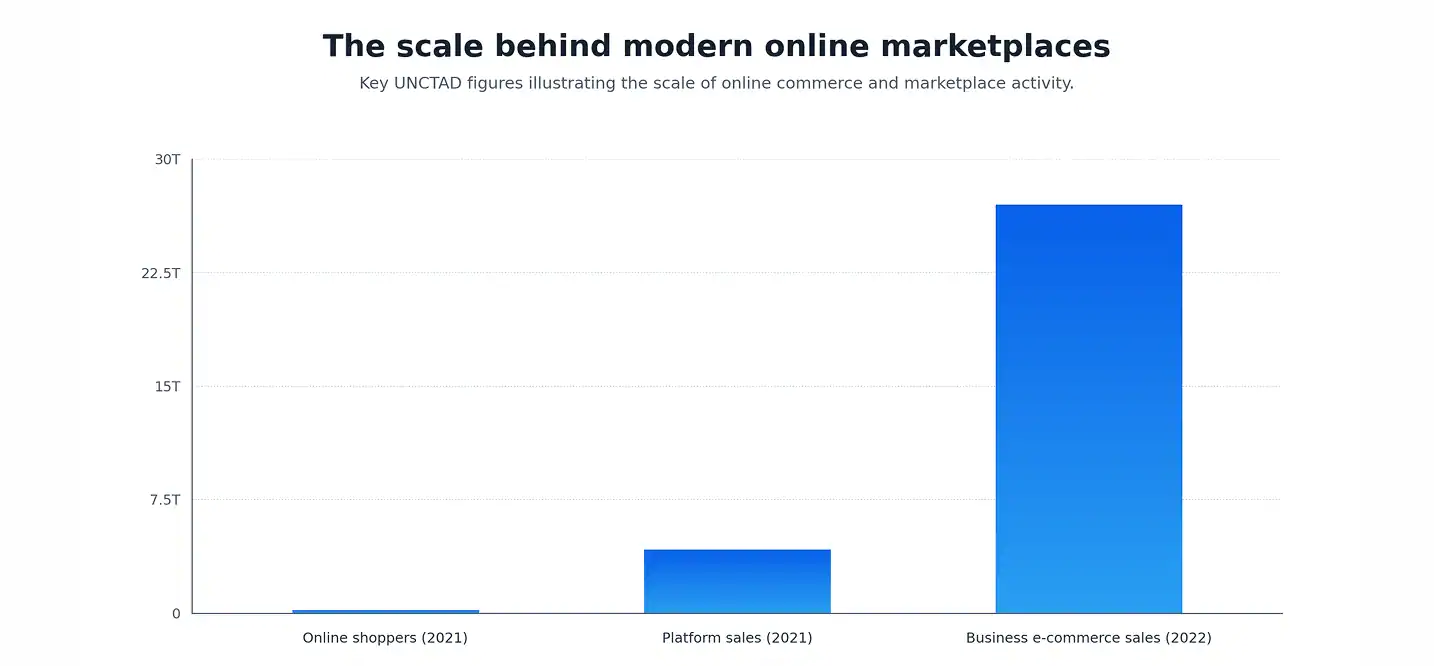
A marketplace has to do more than connect buyers with listings. It must coordinate sellers, transactions, payments, orders, and trust through one platform. This complexity is reflected in the scale of online commerce: UN Trade and Development (UNCTAD) reports that transaction value across the world’s top 35 e-commerce platforms grew from around $2.6 trillion in 2019 to more than $4 trillion in 2021.
The right marketplace platform features depend on the business model, too. Product marketplaces may prioritize inventory and fulfillment, while service and B2B marketplaces can require booking, verification, RFQs, or approval workflows.
This guide covers the essential features, technical requirements, MVP priorities, and common mistakes to consider when building a marketplace platform.
Key Takeaways
- Marketplaces need connected workflows for buyers, sellers, and administrators.
- Core functionality includes search, listings, seller onboarding, payments, orders, trust, and administration.
- Multi-vendor payments must account for commissions, seller balances, payouts, refunds, and transaction records.
- Search, inventory, order management, and seller tools should reflect the marketplace’s business model.
- Security, APIs, mobile experiences, analytics, and scalable infrastructure support the platform underneath.
- An MVP should prove the supply → discovery → transaction → fulfillment loop before advanced capabilities are added.
- Product, service, rental, and B2B marketplaces require different feature priorities.
Essential Marketplace Platform Features at a Glance
| Marketplace area | Core features |
| Buyer experience | Search, filters, listings, recommendations, reviews |
| Seller management | Onboarding, verification, dashboard, catalog |
| Inventory and orders | Inventory sync, OMS, fulfillment, returns |
| Payments | Checkout, payment processing, commissions, payouts |
| Trust and communication | Messaging, ratings, verification, disputes |
| Administration | Vendor management, moderation, analytics |
| Mobile | Mobile-first UX, responsive checkout, seller workflows |
| Integrations | Payment, shipping, ERP, CRM, inventory APIs |
| Technical foundation | Security, scalability, performance, observability |
These capabilities are interconnected. Search depends on structured listing data. Checkout depends on pricing and availability. Seller payouts depend on transaction and commission records. Dispute management depends on order, payment, and communication data.
What Makes a Marketplace Platform Successful?
A successful marketplace reduces friction for every participant while giving the operator enough control to manage the platform. Here are some traits of a successful marketplace platform:
1. Low-Friction Participation
Buyers should be able to register, browse, compare, and transact without unnecessary steps. Sellers need an equally clear path from registration to verification, listing creation, and receiving orders or bookings.
2. Efficient Discovery
A large catalog is useful only when buyers can find relevant listings quickly. Search needs to account for categories, attributes, price, location, availability, and relevance rather than simply matching words in a title.
3. Reliable Transactions
The platform needs to connect a customer’s action to the correct seller or provider. That includes checkout, payment authorization, order or booking creation, fulfillment, refunds, and seller payouts.
4. Seller Self-Service
As the vendor base grows, administrators cannot manually update every listing, price, order, or inventory record. Seller dashboards should handle routine operations without constant platform intervention.
5. Trust and Safety
Verification, ratings, reviews, secure payments, moderation, fraud controls, and dispute workflows help reduce uncertainty between marketplace participants.
6. Operational Visibility
Marketplace operators need visibility into sellers, listings, transactions, commissions, refunds, disputes, and performance. The administrative layer is therefore part of the product, not simply an internal reporting tool.
7. Technical Scalability
The architecture needs to accommodate growth in users, sellers, listings, orders, transactions, integrations, and background processes without making every increase in volume a performance problem.
A practical example is Cubix’s Auto-Connect, positioned as an automotive marketplace for buyers and sellers. It demonstrates the fundamental two-sided marketplace model, where the platform has to support both sides of the transaction rather than operate as a single merchant.
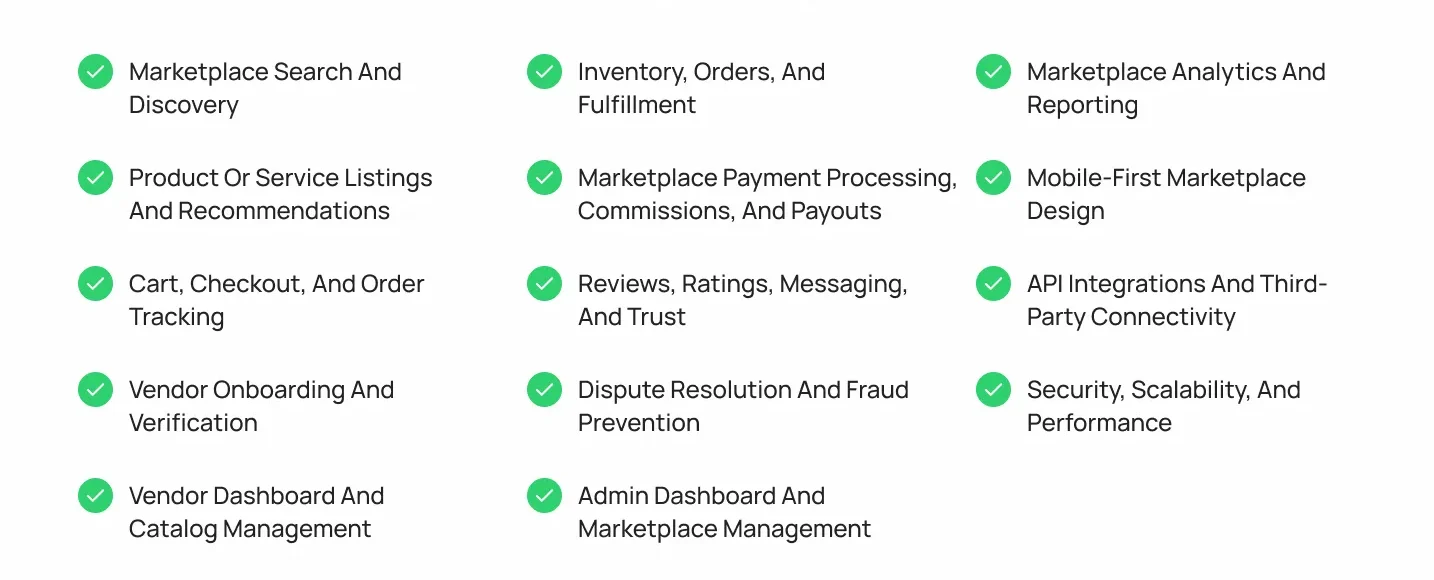
Essential Features Every Marketplace Platform Needs
1. Marketplace Search and Discovery
Marketplace search and discovery becomes increasingly important as listing volume grows.
A capable marketplace search system can include:
- Keyword search
- Autocomplete
- Search suggestions
- Category navigation
- Faceted filtering
- Sorting
- Location-based search
- Price and availability filters
- Attribute-based filtering
- Synonyms
- Typo tolerance
- Relevance ranking
- Personalized results
- Semantic or vector search where appropriate
A useful way to model the search pipeline is:
Query → Retrieval → Filtering → Ranking → Personalization → Result
For example, a buyer searching for “running shoes” may expect results to account for brand, size, price, location, availability, ratings, and relevance instead of simply returning listings containing those words.
Typo tolerance can help users recover from common spelling mistakes without returning an empty result set. Search platforms such as Algolia document typo tolerance as a mechanism for matching queries that contain spelling errors while still applying relevance rules.
Advanced semantic or vector search should not be treated as mandatory for every marketplace. A small marketplace with a structured catalog may achieve excellent results through conventional keyword search, facets, taxonomy, and ranking. More sophisticated retrieval becomes useful when catalogs, attributes, and natural-language queries become harder to model with traditional matching.
2. Product or Service Listings and Recommendations
Listings are the marketplace’s primary supply-side content. They should provide enough structured information for users to evaluate an offer before making a transaction.
Depending on the marketplace, a listing can include:
- Product or service name
- Images and video
- Description
- Structured attributes
- Variants
- Pricing
- Availability
- Seller or provider information
- Ratings and reviews
- Delivery or service details
- Cancellation or return terms
Recommendations can extend discovery through related products, similar services, recently viewed listings, or personalized suggestions.
The underlying data model matters. A product marketplace may need SKUs, variants, dimensions, and inventory. A service marketplace may need provider profiles, service areas, pricing models, and availability. A rental marketplace may require calendars, booking rules, deposits, and duration-based pricing.
3. Cart, Checkout, and Order Tracking
For product marketplaces, the cart connects discovery with the transaction. It should clearly display selected items, prices, applicable discounts, delivery information, and the next payment step.
Depending on the business model, checkout may include:
- Single or multi-vendor carts
- Guest checkout
- Saved carts
- Address management
- Delivery options
- Payment method selection
- Order confirmation
- Order status
- Shipment tracking
- Cancellation
- Returns
- Refunds
Multi-vendor carts introduce additional complexity because one customer checkout can contain products from several sellers. The platform needs to associate each line item with the correct seller, fulfillment workflow, commission rule, and payout record.
Cart Abandonment Prevention
Cart abandonment prevention is primarily about removing unnecessary friction.
Useful mechanisms include:
- Persistent carts
- Fewer checkout steps
- Transparent delivery and service costs
- Mobile-friendly forms
- Saved customer information
- Relevant payment options
- Transaction reminders
The right combination should be based on marketplace analytics and customer behavior rather than copied from another ecommerce business.
4. Vendor Onboarding and Verification
A vendor onboarding workflow determines how a seller moves from registration to becoming an active participant on the marketplace.
A practical flow is:
Registration → Verification → Approval → Store/Profile Setup → Listing Creation → Activation
Depending on the marketplace, onboarding may collect:
- Individual or business information
- Contact details
- Identity verification
- Business verification
- Tax information
- Bank or payout details
- Seller agreements
- Product or service categories
- Operating locations
- Service areas
Verification requirements vary by business model, payment provider, jurisdiction, and risk profile. They should therefore be defined during requirements planning rather than treated as a universal checklist.
Role-based access control also matters when sellers, support teams, moderators, and administrators need different permissions.
A structured onboarding workflow gives the platform better control over who can list, sell, or provide services while reducing repetitive manual operations.
5. Vendor Dashboard and Catalog Management
The seller dashboard acts as the seller’s operating console.
A robust vendor management system can allow sellers to:
- Create and edit listings
- Manage product attributes
- Upload images and media
- Set prices
- Manage variants
- Update availability
- Track orders
- View earnings
- Monitor listing performance
- Respond to customers
- Manage storefronts or provider profiles
Catalog management becomes increasingly important as the number of listings grows. Structured categories, attributes, validation rules, approval states, and bulk operations help maintain consistent product data.
The dashboard should also expose the information sellers need to operate: pending orders, inventory alerts, sales, payouts, messages, and listing issues.
6. Inventory, Orders, and Fulfillment
Inventory and order management connect what sellers offer with what customers can actually purchase.
A marketplace may need:
- SKU management
- Stock tracking
- Availability status
- Inventory reservations
- Low-stock alerts
- Multi-location inventory
- Real-time inventory synchronization
- Order routing
- Fulfillment status
- Shipping integrations
- Delivery tracking
- Returns
- Cancellations
- Refund workflows
Order Management System (OMS)
An order management system (OMS) can coordinate the transaction after checkout:
Order placed → Payment confirmed → Order routed → Fulfillment → Shipment → Delivery → Completion or return
This becomes more complex when one customer order contains products from multiple sellers. The marketplace may need seller-specific fulfillment records while preserving a unified customer order experience.
Cubix’s Foodly project provides a relevant example of this operational layer. The platform includes restaurant discovery, order tracking, a streamlined order management system, and real-time order tracking.
7. Marketplace Payment Processing, Commissions, and Payouts
A marketplace payment processing system has a different architecture from a conventional ecommerce checkout because money may need to move between multiple parties.
A simplified flow is:
Buyer payment → Marketplace transaction → Commission calculation → Seller balance → Payout
The platform may need:
- Payment gateway integration
- Credit and debit cards
- Digital wallets
- Region-specific payment methods
- Split payments
- Platform commissions
- Seller balances
- Payout schedules
- Manual payouts where required
- Refunds
- Partial refunds
- Chargebacks
- Transaction records
- Currency handling
- Payment webhooks
- Seller payment onboarding
The exact payment architecture depends on the marketplace model and payment provider. Stripe’s marketplace documentation, for example, distinguishes between destination charges and separate charges and transfers. The latter can support scenarios where one customer payment needs to be distributed across multiple connected accounts.
Payouts also require their own workflow. A marketplace may need to control payout timing, monitor balances, handle failed transfers, and track payout events rather than treating seller payouts as an automatic extension of checkout.
This distinction matters because payment architecture affects commissions, refunds, chargebacks, seller balances, reconciliation, compliance responsibilities, and operational workload.
8. Reviews, Ratings, Messaging, and Trust
Marketplace trust is built through several interacting features rather than a star-rating component alone.
Useful capabilities include:
- Seller and provider profiles
- Ratings
- Reviews
- Verified-purchase reviews where applicable
- Seller verification
- Buyer-seller messaging
- Listing reporting
- Review moderation
- Content moderation
- Communication history
- Transaction-related notifications
Reviews give buyers additional information about products, services, and sellers. Messaging lets participants clarify details before or after a transaction. Verification provides another signal that the person or business behind an account has completed a defined validation process.
The FTC’s guidance for online marketplace buyers also emphasizes reviewing seller information, policies, shipping and return terms, and using safer payment methods.
9. Dispute Resolution and Fraud Prevention
A dispute resolution system gives the marketplace a defined process for handling transactions that do not go as expected.
A structured workflow can include:
Dispute submitted → Evidence collected → Seller response → Admin review → Resolution → Refund or other action → Case closed
The system should preserve relevant transaction details, communication history, evidence, decisions, and status changes.
Fraud prevention can operate alongside this workflow through:
- Seller verification
- Transaction monitoring
- Account activity monitoring
- Velocity checks
- Risk signals
- Suspicious behavior detection
- Manual review
- Account restrictions
- Audit trails
The objective is not to automatically reject every transaction that looks unusual. Effective marketplace risk management combines automated signals with clear procedures for investigation and escalation.
10. Admin Dashboard and Marketplace Management
The administrator dashboard is the operational control layer of a marketplace.
Core functions can include:
- Buyer management
- Vendor management
- Seller approval
- Listing moderation
- Category management
- Product approval
- Commission configuration
- Order monitoring
- Refund management
- Dispute handling
- User roles and permissions
- Content management
- Transaction monitoring
- Platform configuration
- Audit logs
The admin layer should be designed around operational exceptions as well as routine management.
An administrator may need to suspend a seller, approve a listing, investigate a transaction, review a dispute, change a commission rule, or determine why an order failed. Those workflows require more than a dashboard containing charts.
For marketplaces with enterprise customers or internal teams, role-based permissions, integrations, workflow automation, and centralized administration become even more important. Cubix’s guide to enterprise application features covers these broader requirements in greater detail.
11. Marketplace Analytics and Reporting
Marketplace analytics should serve both sellers and platform operators.
Seller analytics
Sellers may need visibility into:
- Orders
- Sales
- Revenue
- Listing views
- Conversion
- Product performance
- Customer activity
- Payouts
Platform analytics
Marketplace operators can monitor:
- Gross merchandise value (GMV)
- Transaction volume
- Active buyers
- Active sellers
- Conversion rate
- Repeat purchases
- Retention
- Category performance
- Seller performance
- Refund rates
- Dispute rates
- Average order value
- Take rate
The purpose of analytics is not simply to display numbers. It should help operators understand where the marketplace transaction flow is working or breaking down.
For example, lower completed transactions could result from poor search relevance, insufficient seller availability, payment failures, fulfillment problems, or checkout friction. Analytics should help identify those relationships.
12. Mobile-First Marketplace Design
A mobile-first marketplace design should account for how buyers and sellers complete tasks on smaller screens.
Important workflows include:
- Mobile registration
- Search
- Filtering
- Listing comparison
- Product or service selection
- Checkout
- Payment
- Order tracking
- Seller listing management
- Inventory updates
- Messaging
- Notifications
Mobile-first does not simply mean making a desktop interface responsive. Navigation, information hierarchy, forms, touch targets, filtering, checkout, and seller workflows may all need to be reconsidered for mobile use.
For marketplaces with frequent repeat transactions, native iOS or Android applications may make sense. For others, a responsive web application or progressive web app may be sufficient. The choice should follow usage patterns and workflow requirements.
13. API Integrations and Third-Party Connectivity
A marketplace rarely operates as an isolated application.
Common integrations include:
- Payment providers
- Shipping and logistics systems
- ERP platforms
- CRM systems
- Inventory management software
- Tax services
- Analytics platforms
- Marketing tools
- Authentication providers
- Search services
- Communication platforms
APIs provide the connection layer, while webhooks can communicate events such as payment completion, payout status, order changes, or inventory updates.
The architecture should distinguish core marketplace logic from external services. That makes it easier to replace or extend an integration without rewriting the entire transaction system.
For marketplaces delivered primarily through web applications, Cubix’s web development services cover custom web applications, ecommerce platforms, PWAs, APIs, and related web technologies.
14. Security, Scalability, and Performance
Security should be part of the marketplace architecture rather than a final layer added before launch.
1. Security
A marketplace can require:
- Authentication
- Authorization
- Role-based access control
- Encryption
- Secure payment integrations
- Data protection
- Session security
- Audit logs
- Fraud monitoring
- Secure API access
Role separation is especially important because buyers, sellers, moderators, support staff, and administrators should not automatically have the same permissions.
OWASP distinguishes authentication from authorization and recommends enforcing authorization controls on the trusted server side rather than relying solely on client-side restrictions.
2. Scalability
Marketplace scalability involves more than handling additional website visitors.
The architecture may need to scale across:
Users + Sellers + Listings + Orders + Transactions + API calls + Background jobs + Operational events
Relevant architectural considerations include:
- Cloud infrastructure
- Horizontal scaling
- Database optimization
- Caching
- CDN delivery
- Queue-based processing
- Search infrastructure
- API scalability
- Load management
- Monitoring and observability
A marketplace should also avoid making every transaction dependent on a single synchronous process when certain operations can safely run asynchronously.
Cubix’s guide to building scalable marketplaces provides additional context around marketplace scalability and the technology considerations involved.
3. Performance
Marketplace performance affects search, listing pages, checkout, seller dashboards, and administrative workflows.
Teams should monitor:
- Page rendering
- API response times
- Search latency
- Database queries
- Image and asset delivery
- JavaScript execution
- Core Web Vitals
Google’s web.dev documentation identifies LCP, INP, and CLS as Core Web Vitals and recommends real-user monitoring alongside other measurement tools for understanding field performance.
Performance optimization therefore needs to cover both frontend and backend systems. A fast interface cannot compensate for slow search APIs, inefficient database queries, or overloaded transaction services.
Marketplace Platform Requirements: A Practical Checklist

Use this checklist to evaluate a marketplace platform before development:
| Requirement | What to evaluate |
| Buyer accounts | Registration, authentication, profiles |
| Seller onboarding | Verification, approval, agreements |
| Vendor management | Dashboards, listings, orders, earnings |
| Search and discovery | Search, filters, ranking, taxonomy |
| Listings | Products/services, attributes, media |
| Inventory | Stock, availability, synchronization |
| Payments | Gateway, split payments, refunds |
| Commissions | Rules, calculation, reporting |
| Payouts | Seller balances, schedules, reconciliation |
| Orders/bookings | Status, fulfillment, cancellation |
| Trust | Reviews, verification, messaging |
| Disputes | Evidence, escalation, resolution |
| Administration | Moderation, users, configuration |
| Analytics | Marketplace and seller reporting |
| Integrations | Payment, ERP, CRM, shipping, APIs |
| Security | Authentication, authorization, auditability |
| Scalability | Infrastructure, database, APIs |
| Mobile | Responsive and mobile-first workflows |
This checklist is a requirements framework, not a universal build specification. A marketplace for physical goods will have different requirements from a B2B services marketplace or a rental platform.
Which Marketplace Features Should Be Included in an MVP?
An MVP should prove that the core marketplace transaction works. It does not need every advanced capability at launch.
MVP: Prove the Transaction Loop
Buyer
- Account creation
- Search and filtering
- Listing details
- Cart, booking, or request flow
- Checkout/payment
- Order or booking status
Seller
- Registration
- Verification
- Listing creation
- Seller dashboard
- Order or booking management
- Earnings and payout visibility
Admin
- Seller approval
- Listing moderation
- User management
- Commission configuration
- Essential dispute/refund management
- Basic analytics
Trust
- Ratings/reviews
- Basic verification
- Essential fraud controls
Growth-Stage Features
Once the core transaction works, the platform can introduce:
- Advanced recommendations
- Semantic search
- Real-time inventory synchronization
- Automated verification
- Advanced fraud detection
- Advanced analytics
- Automated dispute workflows
- Native mobile applications
- Personalization
- Seller marketing tools
The important distinction is that MVP does not mean incomplete. It means the platform contains enough functionality to validate the core supply-to-demand transaction without investing prematurely in features that depend on scale or accumulated behavioral data.
How Marketplace Features Vary by Business Model
The phrase “essential marketplace feature” can be misleading because requirements change significantly by marketplace type.
| Feature | Product | Service | Rental | B2B |
| Product catalog | High | Medium | Medium | High |
| Inventory | High | Low/Medium | Availability-based | High |
| Search/filtering | High | High | High | High |
| Provider verification | Medium | High | High | High |
| Booking/calendar | Low | High | High | Medium |
| Shipping | High | Low | Medium | High |
| Reviews | High | High | High | Medium |
| RFQ/quotes | Low | Medium | Low | High |
| Multi-user accounts | Medium | Medium | Medium | High |
| Recurring orders | Medium | Medium | Low | High |
A product marketplace may depend heavily on catalog, SKU, inventory, shipping, and returns. A service marketplace may need provider profiles, availability, location, scheduling, and booking. A rental marketplace may require calendars, deposits, duration-based pricing, and return workflows.
B2B marketplaces can introduce another layer of complexity through company accounts, multiple users per organization, approval hierarchies, negotiated pricing, RFQs, purchase orders, invoices, and account-specific terms.
Cubix’s Vision Sports project is positioned as a product marketplace for fitness enthusiasts, making it a relevant example of how marketplace functionality can be applied to a product-focused use case.
How a Marketplace Transaction Works From Start to Finish
A marketplace can be understood as a connected transaction lifecycle:
Seller onboarding → Listing creation → Search and discovery → Selection → Checkout/booking/request → Payment → Fulfillment → Seller payout → Review/dispute → Analytics
Each stage depends on the systems around it.
Search depends on structured listing data. Checkout depends on accurate pricing and availability. Seller payouts depend on transaction records and commission rules. Dispute handling depends on order, payment, communication, and fulfillment data.
This is why marketplace development should start with workflows and transaction requirements, not simply a collection of screens.
For readers evaluating the architecture and business considerations behind a large marketplace model, Cubix’s guide on creating an online marketplace like eBay provides another relevant resource.
Be one of the Hundred of Brands Cubix has uplifted
Contact Us
Marketplace Feature Mistakes to Avoid
These common mistakes can create friction for buyers, sellers, and marketplace operators even when the platform appears feature-rich.
1. Treating a Marketplace Like Normal Ecommerce
A conventional ecommerce store can often focus on one merchant’s catalog and fulfillment. A marketplace has to coordinate independent sellers, commissions, payouts, seller policies, and operational exceptions.
2. Building the Buyer Experience While Ignoring Sellers
A polished storefront will not create a healthy marketplace if sellers cannot easily create listings, update inventory, manage orders, or understand their earnings.
3. Treating Search as a Basic Text Field
As listing volume grows, keyword matching alone may not provide adequate discovery. Taxonomy, filters, attributes, relevance ranking, location, availability, and other signals can become important.
4. Adding AI Before Fixing Marketplace Data
Semantic search and AI recommendations depend on usable listing data. Poor taxonomy, incomplete attributes, inconsistent product information, and weak metadata can undermine sophisticated search systems.
5. Underbuilding the Admin Layer
Administrators need tools to manage sellers, listings, transactions, disputes, refunds, commissions, permissions, and moderation. These workflows become increasingly important as the marketplace grows.
6. Building Advanced Functionality Before Proving the Transaction Loop
A marketplace does not need every advanced feature at launch. The first priority should be establishing a reliable path from supply to discovery to transaction and fulfillment.
How Much Does It Cost to Build a Marketplace Platform?
A custom marketplace costs around $120,000 to $350,000+, depending on the number of user roles, transaction complexity, integrations, and level of automation required. A simpler MVP can cost less, while enterprise marketplaces with advanced search, real-time inventory, complex payouts, logistics, and AI capabilities can require a significantly larger budget.
| Marketplace scope | Estimated cost |
| Basic marketplace MVP | $30,000–$60,000+ |
| Standard multi-vendor marketplace | $70,000–$150,000+ |
| Advanced marketplace platform | $200,000–$350,000+ |
These ranges are planning estimates rather than fixed quotes. The final cost depends on factors such as:
- Marketplace type and business model
- Buyer, seller, and admin workflows
- Vendor onboarding and verification
- Catalog and inventory complexity
- Search and discovery requirements
- Payment processing, commissions, and seller payouts
- Order, booking, and fulfillment workflows
- Third-party integrations
- Mobile applications
- Security and compliance requirements
- Scalability and infrastructure
- AI recommendations, fraud detection, or automation
For example, a marketplace with basic listings, search, checkout, and manual seller approval requires considerably less engineering than a platform supporting multiple sellers per order, split payments, real-time inventory synchronization, automated verification, dispute management, and logistics integrations.
Building a Marketplace With the Right Feature Set
A marketplace is more than a catalog with checkout added to it. It is a transaction and coordination system that has to work for buyers, sellers, and operators at the same time.
Buyers need efficient discovery, trustworthy listings, convenient transactions, and visibility into orders. Sellers need onboarding, catalog tools, inventory or availability management, order workflows, and transparent payouts. Marketplace operators need administrative controls, analytics, moderation, dispute management, and visibility into platform activity.
Underneath those experiences, APIs, payment infrastructure, security controls, search, databases, integrations, and scalable application architecture keep the system running.
The strongest feature roadmap starts with the marketplace’s actual transaction lifecycle. Build the capabilities needed to connect supply and demand, prove the core transaction, and then expand into advanced search, automation, personalization, analytics, and other capabilities as the platform’s requirements become clearer.
FAQs About Marketplace Platform Features
1. What are the most critical features a marketplace platform must have?
The core requirements usually include buyer and seller accounts, seller onboarding, listings, search and discovery, transactions, payments, order or booking management, seller payouts, trust features, and administrative controls. The exact priority depends on whether the platform supports products, services, rentals, B2B transactions, or another marketplace model.
2. How does a vendor management system impact a marketplace?
A vendor management system gives sellers tools to manage profiles, listings, pricing, inventory, orders, and earnings. For administrators, it provides control over seller approval, permissions, moderation, and performance. This becomes increasingly important as the number of vendors and listings grows.
3. What payment methods should a marketplace support?
Payment methods should reflect the target market, customer behavior, currencies, and available payment infrastructure. Common options include cards and digital wallets, while some marketplaces may need local payment methods or bank-based transactions. The payment architecture must also account for commissions, refunds, and seller payouts.
4. How important is search and discovery for a marketplace?
Search and discovery become increasingly important as listing volume grows. Keyword search, autocomplete, categories, filters, sorting, relevance ranking, location, price, and availability can help users narrow large result sets. Advanced capabilities such as semantic search should be introduced when the marketplace’s catalog and query patterns justify them.
5. How do marketplaces handle disputes and fraud?
Marketplaces can combine seller verification, transaction monitoring, risk signals, reporting mechanisms, and structured dispute workflows. A dispute system can collect evidence, allow relevant parties to respond, route cases for review, and record the resolution. Fraud controls should combine automated detection with appropriate human review.
6. How much does it cost to build a marketplace platform?
The cost depends on the marketplace model, number of user roles, seller workflows, search complexity, payment architecture, inventory or booking requirements, integrations, administration, mobile applications, security, and scalability requirements. A focused MVP can therefore have a very different scope from a large multi-vendor platform.